ALEX ROZE

Evidence · craft · care

Do Black and Grey Tattoos Fade?

Yes. Black-and-grey tattoos can change and appear lighter or softer over time. Pigment can remain in skin for years, but appearance is not fixed: design contrast, scale, placement, healing, ink formulation, and cumulative light exposure all matter. There is no trustworthy universal fade rate, and no sound evidence that lets Alex Roze or Rocky Mountain Tattoo in Kelowna promise that every black-and-grey tattoo will age the same way.

Evidence reviewed 14 August 2026

The supported answer

What published evidence shows

Pigment can persist

A 2018 mouse study found tattoo pigment held by dermal macrophages. When pigment-bearing cells died, incoming macrophages could capture the released particles again. That helps explain persistence despite cell turnover, but the authors did not establish the same mechanism as a measured fading clock in people.

Black pigment has been seen years later

A small 2023 human microscopy study located carbon-black particles inside cells in fresh and older tattoos, including tattoos up to nine years old. This directly supports pigment localization and persistence in human skin. It does not mean the tattoos were visually unchanged, nor does it establish an expiry date.

Light can alter a pigment

Laboratory and mouse experiments found that UVB, natural sunlight, or a solar simulator could decompose Pigment Red 22. This is evidence that light-driven chemistry can occur. It does not prove how fast carbon-black ink fades in human skin, because the pigment, study model, exposure, and outcome are different.

The research base is limited

A systematic review found relatively little published work on tattoo-pigment photolysis and metabolism. Separate research shows that products sold as black tattoo ink can contain very different mixtures. Treating every black ink, every body site, or every design as one predictable material would go beyond the evidence.

The uncertainty belongs on the page

What it does not show

No trustworthy evidence found for a universal black-and-grey-versus-colour longevity ranking. “Black and grey” describes a visual approach, not one standardized ink formula, needle grouping, design density, placement, healing course, or amount of future sun exposure.

The sources also do not provide a defensible percentage loss per year or a date when a tattoo becomes “faded.” A person may use that word for softened fine detail, reduced contrast between adjacent values, lighter pigment, a changed skin surface, or all of those together. Those are not interchangeable measurements.

A responsible answer is conditional: black-and-grey work can change over time, and its future appearance cannot be guaranteed from a style label. The studies explain parts of persistence and degradation; they do not predict one client's result.

Practitioner guidance, clearly labelled

Alex's design approach

The cited pigment and sunlight studies are published evidence. The following is Alex's craft approach after 16 years of tattooing: design the piece for its real physical size and placement, preserve a readable range from dark to open skin, and avoid relying on tiny value differences to carry every important feature.

Black-and-grey realism creates form through light and shadow. Portraits, animals, horror, surreal imagery, and micro realism can all use that language, but they do not need the same scale. A forearm panel, wrapping sleeve, hand, rib, and back piece provide different space and viewing distance. The tattoo process explains why placement and scale are resolved before drawing.

Look at finished work, not an abstract longevity score. Alex's black-and-grey portfolio shows how value and composition change across subjects. The style comparison explains how this differs from traditional, neo-traditional, and cyberpunk anime without declaring a universal winner.
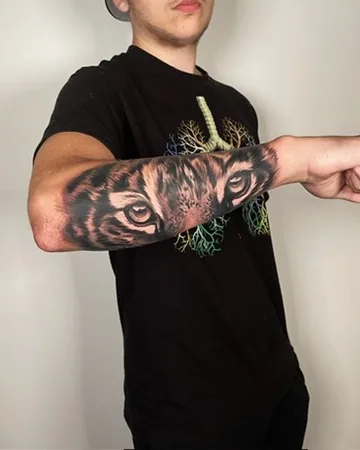
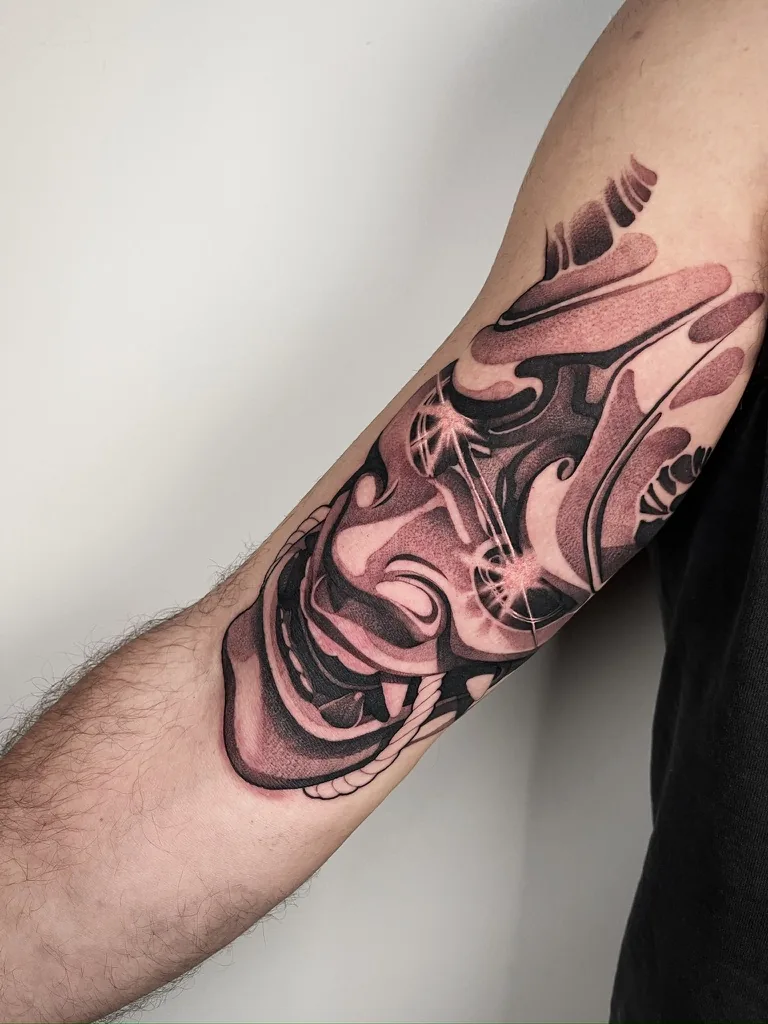
Tiger eyes forearm, black-and-grey tattoo by Alex Roze Hannya mask, black-and-grey tattoo by Alex Roze

Healing first, long-term protection second

Care without crossing the medical boundary

A fresh tattoo and a healed tattoo need different instructions. During healing, follow the bandage and client-specific guidance you receive from the artist. Use Alex's tattoo aftercare guide for that protocol, and contact an appropriate healthcare service if you have concerning symptoms. A general search answer cannot diagnose healing.

Only after the tattoo has healed should general sun-protection guidance be applied to the exposed tattoo. Health Canada recommends shade or covering exposed skin and a broad-spectrum sunscreen with SPF 30 or higher. Sunscreen is one part of general sun safety; it cannot guarantee that a tattoo's appearance will remain unchanged.

If the future readability of a detailed idea is the concern, discuss subject, placement, and approximate size before booking. Alex can explain how he would simplify or separate forms for the proposed location, but cannot promise a fixed aging result. Start with the tattoo enquiry only when you are ready to discuss a real project.

Visible provenance

Sources and limits

Short answers

Black-and-grey fading FAQ

Do black and grey tattoos fade?

Yes. Black-and-grey tattoos can change and appear lighter or softer over time. Research supports pigment persistence and shows that light can decompose at least some pigments, but it does not provide a universal fade rate for human black-and-grey tattoos.

Does black and grey last longer than colour?

No trustworthy evidence establishes a universal ranking. Ink formulation, design contrast, scale, placement, healing, and light exposure vary, so the style name alone cannot promise longevity. Compare the actual design strategy rather than treating a category as a durability score.

How can I protect a healed tattoo from the sun?

After healing, follow general sun-safety guidance: seek shade or cover exposed skin and use broad-spectrum sunscreen with SPF 30 or higher. During healing, follow tattoo-specific instructions instead of treating a general sun page as fresh-tattoo care.