Japanese-inspired motifs · three styles · Kelowna
Japanese-Inspired Tattoos in Kelowna
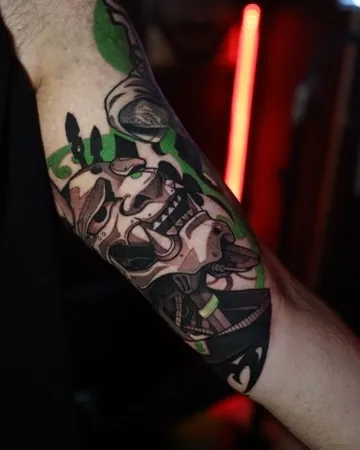
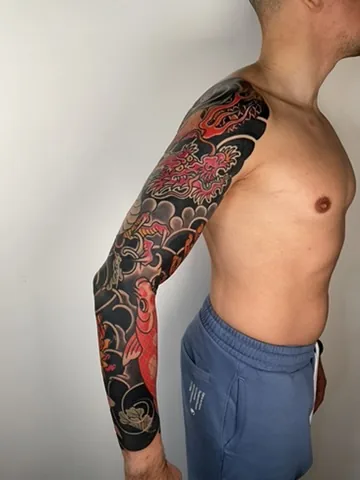
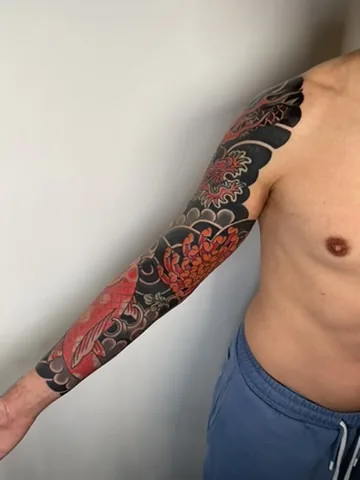
Alex Roze tattoos Japanese-inspired motifs at Rocky Mountain Tattoo, 532 Bernard Avenue in downtown Kelowna. This page contains exactly seven visually reviewed works: dragon-and-samurai, oni-mask, kitsune-mask, Hannya-mask, dragon-and-koi, and koi-and-chrysanthemum compositions across cyberpunk anime, black-and-grey, and traditional portfolios.
Portfolio and sources reviewed 14 August 2026
7 reviewed works
Japanese-inspired tattoo portfolio
Every included photograph carries a dated motif-specific visual review in the site's image taxonomy. Two caption candidates were rejected after direct inspection: one shows an anime character without verifiable samurai attributes, and one shows two women with a rabbit and flowers rather than the claimed Hannya composition. The seven retained works are the complete reviewed evidence set for this page.
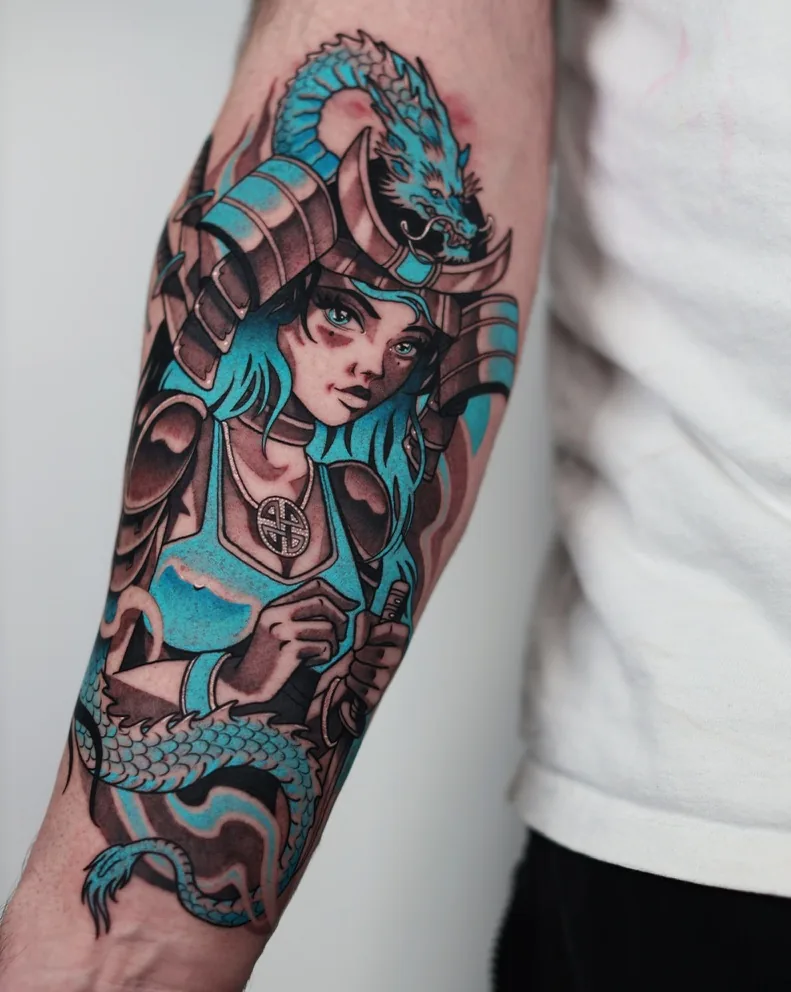
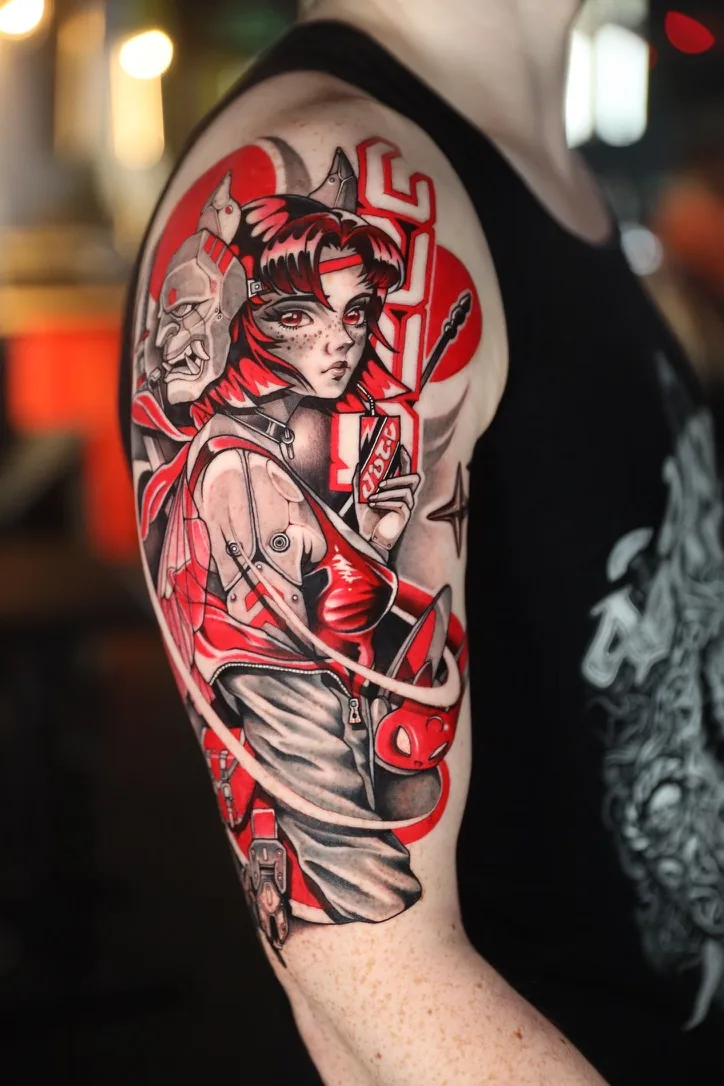
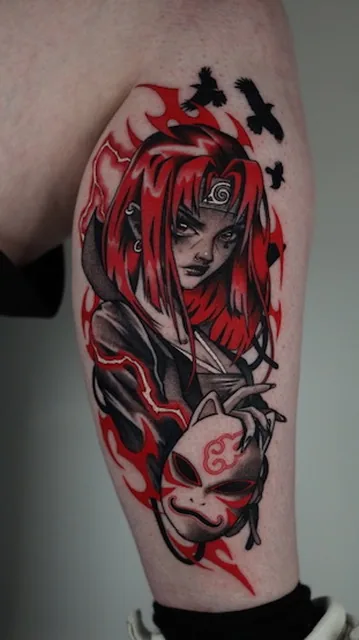
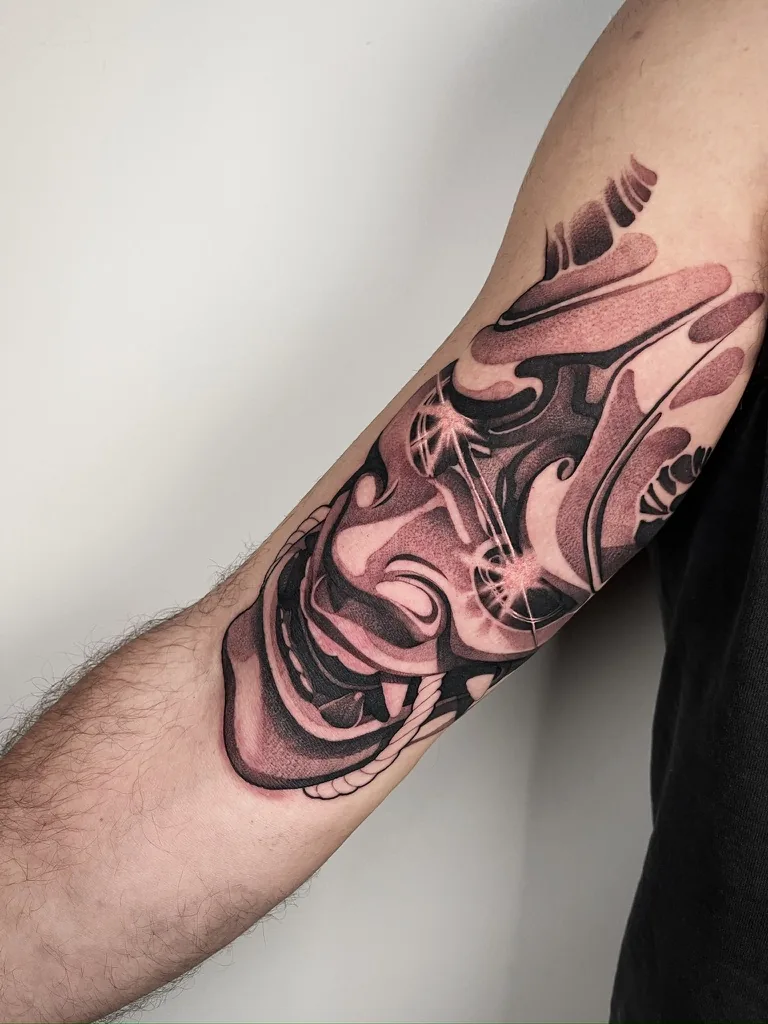
Portfolio inclusion proves that a named Japanese-inspired motif is clearly visible in the finished photograph. It does not establish classical Japanese or irezumi specialization, tebori practice, apprenticeship or lineage, cultural authority, universal symbolism, historical accuracy, project acceptance, or a promised price, session count, healing result, longevity, or outcome.
Read the evidence
Seven reviewed works, three different visual systems
The reviewed set contains four cyberpunk anime works, one black-and-grey Hannya mask, and two traditional sleeve compositions. The anime pieces combine a blue dragon with a samurai-armoured character, an oni mask with a red character panel, a kitsune mask with a character composition, and a green oni or samurai-mask sleeve component. The shared evidence is visible motif use, not one repeated Japanese tattoo method.
The black-and-grey example isolates a Hannya mask through value, open skin, and a large bent-arm shape. The traditional sleeves organize dragon, koi, chrysanthemum, dark background, and connected movement across the arm. Those works solve different problems from the anime panels even when a mask, dragon, or armour reference overlaps. Compare structure and body flow before treating a motif name as a complete design brief.
Two legacy labels failed direct review. The first photograph shows a red-haired anime character but does not provide enough visible evidence for the word samurai. The second shows two women with a rabbit and flowers, not the claimed mask-and-geisha composition. Both remain outside this collection and their captions were corrected. Searchable text cannot substitute for inspecting the finished work.
Name the motif
Start with the subject, source, and version you actually mean
Name the visible subject as precisely as you can: dragon, koi, Hannya mask, oni mask, kitsune mask, chrysanthemum, armour, cloud structure, a specific anime character, or another referenced element. Do not assume those terms are interchangeable. Send the source image and mark the silhouette, expression, pose, colours, objects, or relationships that must remain recognizable.
If the idea comes from a specific story, game, manga, anime, print, mask tradition, family reference, or historical object, name that source. A generic image-search screenshot may omit the context needed to distinguish a character design from a traditional motif. This page does not authenticate a reference or assign it to a period, school, theatre form, folklore, religion, or tattoo lineage.
Separate required content from atmosphere. Required may mean one mask type, a koi direction, a dragon head, a flower relationship, or a character costume. Atmosphere may mean smoke, water, cloud, wind, sparks, dark background, or a limited accent colour. A short hierarchy protects the subject that must read first and exposes where more source research is needed.
Use accurate labels
Japanese-inspired is not the same claim as classical Japanese tattooing
This page uses Japanese-inspired because the reviewed portfolio crosses anime character work, mask motifs, and traditional-style sleeves. It does not describe Alex as a classical Japanese or irezumi specialist, a tebori practitioner, or part of a Japanese tattoo lineage. Those are claims about training, method, practice, and cultural context that cannot be created from visual similarity or keyword demand.
If your priority is a strict traditional Japanese method, lineage, body-suit system, historically specific composition, or hand-poked tebori process, state that before booking and ask whether Alex is the right fit. The existence of a koi, dragon, Hannya, oni, or kitsune in a portfolio does not by itself answer that question. An honest fit decision is more useful than silently collapsing different practices into one search phrase.
If your priority is Alex's cyberpunk anime, black-and-grey, or traditional visual language applied to a clearly sourced motif, link the closest parent portfolio. Explain whether the useful property is graphic colour, character framing, black-and-grey value, mask scale, sleeve flow, bold outline, or connected background. That makes the request specific without inventing a credential.
Do not invent meaning
Provide cultural and personal context instead of assuming symbolism
A motif can carry different meanings across stories, periods, communities, families, and individual projects. This page does not state that every koi, dragon, Hannya, oni, kitsune, flower, colour, or direction has one universal meaning. If symbolism matters, write the intended meaning in your own words and include the source you trust for that interpretation.
Explain whether the reference is personal, aesthetic, narrative, memorial, religious, cultural, or connected to a specific fictional work. Identify anything you do not want combined or altered. If you are uncertain about a term, say so. Uncertainty can be researched; a confident but unsupported label can send the design in the wrong direction and later become inaccurate public metadata.
For text, seals, names, dates, or characters, type the exact content separately from the image and identify the language and source. Do not rely on copied lettering or machine translation without review. This page cannot validate spelling, calligraphy, translation, cultural suitability, copyright status, or the meaning of a symbol embedded in a reference.
Build the composition
Decide whether the project is a panel, mask, or connected body system
The reviewed anime works behave like bounded character panels or large components. The Hannya mask follows one bent-arm area. The koi-and-dragon examples connect multiple motifs, background, and directional movement through a sleeve. Choose whether the project should stand alone, fill one measured panel, connect to existing work, or reserve space for a larger composition before listing decorative details.
A connected arm design needs a clear primary read and a plan for transitions. List primary, supporting, optional, and unwanted elements. If a dragon, koi, mask, character, flower, water, cloud, text, and background all appear in the references, identify which element should land first and which can recede. The gallery cannot prove that every requested object fits one placement.
Use the sleeve guide when the project extends across a large arm area. It distinguishes complete-arm evidence from large components and explains why one photograph cannot establish another client's sessions, hours, dimensions, pain, or final cost. For a smaller panel, send the precise available height and width rather than describing the piece only as small, medium, or large.
Design for the body
Give placement, orientation, and future connections as constraints
Name the exact body side and surface and provide approximate longest dimensions in centimetres or inches. Send one straight, well-lit close photograph and one wider view that shows body direction, curvature, nearby tattoos, and the full available area. State which direction the face, animal, mask, flower, water, or other moving element should travel.
If the new work must connect to an existing sleeve, approach a scar, cover an older tattoo, or preserve room for a future stage, include every relevant edge. A finished portfolio image cannot establish whether a different placement, cover-up, scar, pigment, or surrounding linework is feasible. Those conditions require project-specific photographs and review.
Do not derive price or session count from the apparent size of a portfolio photograph. Motif count, reference accuracy, style, background, line weight, colour, placement, existing work, and the amount of connected body area affect design and estimate. Measured constraints make the first response more decidable than a screenshot with no scale.
Make the enquiry decidable
What to send for a Japanese-inspired tattoo project
Send the exact motif or source, required visible features, intended meaning in your own words, closest Alex portfolio examples, primary and supporting elements, unwanted imagery, exact body side and surface, measured size, placement photographs, colour direction, existing tattoos, budget, and date constraints. State whether the project stands alone or belongs to a future sleeve or larger body composition.
Say whether you want Alex's anime, black-and-grey, or traditional visual language, or whether you require a strict Japanese method, lineage, historical system, or tebori process. That distinction may change the fit decision. This page supplies portfolio and planning evidence; it does not promise that Alex accepts every cultural reference or that he is the correct specialist for every Japanese tattoo request.
Alex's published rates are $280 CAD per hour and $2,000 CAD for a full day, but those figures are not a quote for a Japanese-inspired project. Submit the online enquiry for review, questions, an estimate, a possible date, and the next deposit step. Sending the form does not confirm availability, reply time, acceptance, cultural or historical accuracy, price, sessions, cover-up feasibility, or outcome.
Direct answers
Japanese-inspired tattoo questions
Where does Alex Roze tattoo Japanese-inspired projects?
Alex tattoos at Rocky Mountain Tattoo, 532 Bernard Avenue in downtown Kelowna. Confirm the artist, date, and address in the final appointment details.
What Japanese-inspired motifs appear in Alex's reviewed portfolio?
The seven reviewed works include dragon, koi, chrysanthemum, Hannya, oni, kitsune, and samurai-armour references across cyberpunk anime, black-and-grey, and traditional treatment.
Does this page claim Alex is a traditional Japanese or irezumi specialist?
No. It documents Japanese-inspired motifs in Alex's reviewed portfolio. It does not claim classical Japanese specialization, tebori practice, apprenticeship, lineage, cultural authority, or historical authentication.
What should I send for a Japanese-inspired tattoo enquiry?
Send the exact motif and source, required features, intended meaning, closest portfolio examples, primary and supporting elements, exact body side and surface, measured size, placement photos, colour direction, budget, and date constraints.
Can this page estimate the price or sessions for my project?
No. Motif count, reference accuracy, style, background, dimensions, placement, colour, existing work, and connected body area affect the estimate. Send measurable project details for review.
Visible provenance
Sources and boundaries
- Rocky Mountain Tattoo: Alex Roze profile
- Rocky Mountain Tattoo: Contact
- https://alexroze.com/tattoos/cyberpunk-anime
- Alex Roze: Black and grey portfolio
- Alex Roze: Traditional portfolio
The RMT profile supports Alex's published cyberpunk anime, traditional, black-and-grey, and colour style scope; the contact page supports the downtown Kelowna appointment address; Alex's canonical style pages supply the parent portfolios. No irezumi or tebori credential, Japanese apprenticeship, lineage, cultural authority, universal meaning, exact historical identification, fixed price, session count, availability, reply time, healing result, or longevity is inferred.
SEND A JAPANESE-INSPIRED TATTOO ENQUIRY →